

Zigarettenkippen landen massenhaft in der Umwelt
2016 wurden weltweit 5,7 Billionen (5.700.000.000.000) Zigaretten geraucht1. Die Weltgesundheitsorganisation geht davon aus, dass bis zu zwei Drittel davon nach dem Konsum direkt in der Umwelt landen.2 Im Jahr 2020 ergaben Sortieranalysen für eine Studie der INFA GmbH, dass bezogen auf die jährlich etwa 80 Milliarden legal in Deutschland erworbenen Zigaretten mit Filtern ca. 40% im öffentlichen Raum der Städte entsorgt werden.3 Quasi identische Prozentsätze ergaben auch Untersuchungen in Österreich (2012)4 und Frankreich (2019)5. Wird bedacht, dass im Ergebnis der INFA-Studie jene Stummel, die im ländlichen Raum auf Straßen, Wegen, Grünflächen, etc. landen, nicht berücksichtigt sind, darf davon ausgegangen werden, dass in Deutschland weit mehr als die Hälfte der Zigaretten nach dem Konsum direkt in die Umwelt entsorgt wird. Eine Studie der TU Berlin zählte durchschnittlich 2,7 Kippen pro Quadratmeter (!) in zentralen Teilen der Hauptstadt.6 „Die Welt“ (online) zitiert 2020 Berechnungen der Stadtreinigung Hamburg denen zufolge täglich rund 137 Millionen Zigarettenkippen im gesamten Bundesgebiet auf Wegen und Straßen landen.7
In einer Umfrage von 2009 fühlten sich 82% der deutschen BürgerInnen von achtlos weggeworfenen Zigarettenkippen gestört.8 Überraschen mag ein inhaltlicher Widerspruch befragter RaucherInnen: Obwohl 86% Zigarettenkippen als Müll einstuften, gaben drei Viertel von Befragten in den USA an, diese auf den Boden oder aus dem Auto zu werfen.9
Gifte: Von der Kippe in Boden und Gewässer
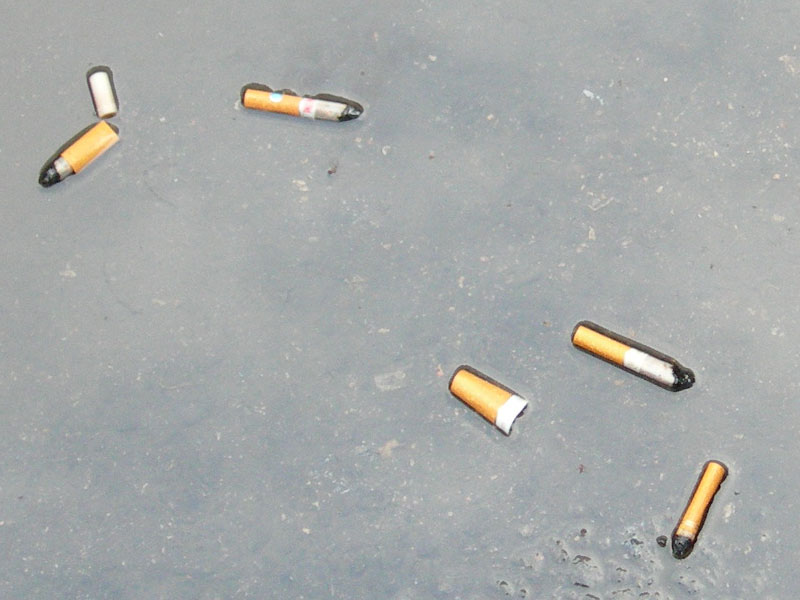

Unter den 4.000 in Zigarettenkippen enthaltenen Substanzen10 befinden sich Nikotin, Arsen, Cadmium, Kupfer, Blei, Benzol, Chrom, Blausäure und Dioxin. Diese sind nicht nur für den Menschen giftig, sondern auch für die Umwelt. Durch Sonneneinstrahlung oder Regenwasser werden Zigarettenstummel in kleinere Bestandteile zerlegt und gelangen so in den Boden und (direkt, durch Verwehung oder über die Kanalisation) in Gewässer.11 Eine Studie zeigt, dass 50% des Nikotins in einem Zigarettenrest bereits nach 30 Minuten herausgelöst sein kann.12 Eine andere weist jene Kohlenwasserstoffe im Boden nach, die in Zigarettenkippen enthalten sind welche dort entsorgt wurden und identifiziert diese als die Quelle für die, z.T. krebserregenden Substanzen.13 Ebenso konnte die Auswaschung von Metallen aus Zigarettenresten und ihre potentielle Schädlichkeit für die Umwelt nachgewiesen werden.14
Fotos: Die Aufheber
Für Tiere und Pflanzen: Zigarettenkippen sind schädlich bis tödlich
 Es wird häufig behauptet, dass ein Zigarettenstummel mehr als 40 Liter Grundwasser vergiftet15 (eine wissenschaftliche Quelle, die dies bestätigt, konnten wir bisher jedoch nicht identifizieren). Nachgewiesen sind hingegen Effekte auf zahlreiche Organismen: Experimente mit Seeringelwürmern,16 Bakterien und Wasserflöhen, Froschembryos17 und Fischen18 zeigen exemplarisch, dass aus Zigaretten gelöste Giftstoffe Tieren erhebliche Schäden zufügen können. Diese reichen von Verhaltensstörungen über Missbildungen und DNA-Veränderungen bis zum Tod. Ein Achtel einer Zigarettenkippe genügte, um alle Wasserflöhe in einem Liter Wasser zu töten.19 Fünf Kippen pro Liter Wasser töteten sämtliche Schnecken darin.20 Die während 24 Stunden aus einer Zigarettenkippe gelösten Giftstoffe reichten aus, um 50% aller Süß- und Salzwasserfische in einem Liter Wasser in einem Zeitraum von 96 Stunden zu töten.21 Wenn größere Tiere (z.B. Hunde)22 und Menschen (z.B. Kleinkinder)23 gefundene Zigarettenkippen verzehren erleiden diese in der Regel gesundheitliche Schäden.24 Auch häufen sich Berichte, wonach Vögel ihren Jungen Zigarettenkippen geben oder Stummel zum Nestbau verwenden – die Folge ist nicht selten der Tod der Nachkommen.
Foto: Bradley Gordon (Flickr); Lizenz: CC BY- 2.0
Endstation Meer
 Über Bäche und Flüsse gelangen große Mengen an Zigarettenkippen auch ins Meer. An stadtnahen Ostseestränden sind (dort entsorgte und angespülte) Stummel die häufigste Art von Unrat. Im Durchschnitt wurden auf 23 Stränden in vier Ländern 302 Kippen pro 100m gefunden.25 Laut dem Bund für Umwelt und Naturschutz Deutschland (BUND), sind über 53% des Mülls an den Stränden der Ostsee Zigarettenkippen. Auch an der Nordsee landen sie bei Müllsammelaktionen regelmäßig in den Top 10 der häufigsten Müllteile.26 Bezugnehmend auf wissenschaftliche Studien, berichten die NBC News, dass Zigarettenrückstände in 70% aller untersuchten Seevögel und in einem Drittel der Meeresschildkröten nachgewiesen wurden.27
Foto: Zak (Flickr); Lizenz: CC BY-SA 2.0
Filter zerfallen zu Mikroplastik
 Neben der toxischen Wirkung von Stoffen, die aus Kippen gelöst werden, ist auch der Zerfall der Filter selbst eine Gefahr für die Umwelt. Zigarettenfilter bestehen in der Regel aus ca. 12.000 Fasern des Kunststoffs Zelluloseacetat und zersetzen sich nach und nach in immer kleinere Bestandteile. Wie lange der Zerfallsprozess dauert, hängt stark von der Umgebung ab, muss aber in jedem Fall in Monaten oder Jahren gemessen werden.28 Eine Serie von Experimenten zur Zersetzung von Zigarettenfiltern in verschiedenen Milieus ergab beispielsweise einen durchschnittlichen Masseverlust von knapp 38% innerhalb von zwei Jahren.29 Britische WissenschaftlerInnen fanden heraus, dass die Zerfallsprodukte der Filter die Keimungsfähigkeit und das Wachstum von Gras und Klee (und somit höchst wahrscheinlich auch von anderen Pflanzen) reduzieren.30 Es ist ferner davon auszugehen, dass, wie Erkenntnisse zum Thema Mikroplastik zeigen.31 auch diese Zerfallsprodukte von Organismen mit Nahrung verwechselt werden. Das bedeutet, dass diese den Verdauungsapparat von Tieren verstopfen und Lebewesen bei vollem Magen sterben. Schließlich ist zu bemerken, dass Giftstoffe in der Natur über die Nahrungskette letztlich wieder den Menschen erreichen. Insbesondere bei Fischen ist hier ein unmittelbarer Zusammenhang gegeben.32
Foto: Die Aufheber
Waldbrände
 Noch ein ganz anderes aber nicht minder wichtiges Kapitel der ökologischen Konsequenzen von weggeworfenen Zigarettenstummeln sind Waldbrände. Diese werden auch in Mitteleuropa aufgrund zunehmend trockener Sommer immer häufiger, wobei der unmittelbare Auslöser in über 90% der Fälle menschliches Handeln ist. Hierbei nehmen achtlos weggeworfene Kippen einen besonders hohen Stellenwert ein. Für Österreich geht das Institut für Waldbau der Wiener Universität für Bodenkultur sogar davon aus, dass sie vermutlich sogar die häufigste Ursache aller Brände darstellen.
Foto: Berknot (Flickr); Lizenz: CC BY-SA 2.0
Referenzen
- The Tobacco Atlas / American Cancer Society and Vital Strategies. Online Dokument. Eingesehen am 15.4.2021
- WHO (2017). Tobacco and its environmental impact: An Overview. Genf: Die Weltgesundheitsorganisation. S. 38
- nicht publiziertes Nebenergebnis von: Gellenbeck, K. & Reuter, R. (2020). Ermittlung von Mengenanteilen und Kosten für die Sammlung und Entsorgung von Einwegkunststoffprodukten im öffentlichen Raum. Ahlen: INFA-Institut für Abfall, Abwasser und Infrastruktur- Management GmbH
- Institut für empirische Sozialforschung (IFES) im Auftrag der Magistratsabteilung 48 der Stadt Wien; kommuniziert im Leistungsbericht der MA 48 von 2012, S.71.
- Enotiko (2019). Perspective D’Une Filiere Rep Megots: Rapport D'Etat Des Lieux. Paris: Enotiko. S.3
- Roder Green et al. (2014). Littered cigarette butts as a source of nicotine in urban waters. Journal of Hydrology, 519, S. 3466–3474.
- Birger, N. (2020). Bald gibt es noch mehr Warnungen auf Zigarettenschachteln. Die Welt (online). 20.11.2020. Anmerkung: Leider erhielten wir auf mehrfache Bitte die zitierte Quelle näher zu beschreiben keine Antwort von der Stadtreinigung Hamburg.
- Reader’s Digest Deutschland (2009). 92 Prozent der Deutschen stören sich an wild entsorgtem Müll.
- Rath, J. M. et al. (2012). Cigarette Litter: Smokers’ Attitudes and Behaviors. International Journal of Environmental Research and Public Health, 9(6), S. 2189–2203
- Slaughter, E. et al., ibid.. Die Weltgesundheitsorganisation geht sogar von 7.000 Substanzen aus; WHO (2017). Tobacco and its environmental impact: an overview. Genf: Die Weltgesundheitsorganisation. S. 24
- Hon N.-S. (1977). Photodegradation of Cellulose Acetate Fibers. Journal of Polymer Science, 15, S. 725-744; Wicke, D. et al (2017). Spurenstoffe im Regenwasserabfluss Berlins. Korrespondenz Abwasser, Abfall, Nr. 5; Novotny, T. E. et al. (2009). Cigarettes Butts and the Case for an Environmental Policy on Hazardous Cigarette Waste. International Journal of Environmental Research and Public Health, 6(5), 1691–1705; Luke, J. A. (1991). Degradibility of filter materials and plastics packaging. In: BATCo meeting Impacts of Environmental Regulations on Packing and Product. British American Tobacco, 20, S. 401341580-401341583.
- Roder Green et al., ibid.
- Moriwaki, H. et al (2009). Waste on the roadside, ‘poi-sute’ waste: Its distribution and elution potential of pollutants into environment. Waste Management, 29(3), S. 1192–1197.
- Moerman, J. W. & Potts, G. E. (2011). Analysis of metals leached from smoked cigarette litter. Tobacco Control, 20(Suppl 1), S. i30–i35.;
Dobaradaran, S. et al (2017). Association of metals (Cd, Fe, As, Ni, Cu, Zn and Mn) with cigarette butts in northern part of the Persian Gulf. Tobacco Control, 26(4), 461–463. - z.B. Naturschutzbund Österreich (2018). Kleine Ursache, große Wirkung: Zigarettenstummel in der Umwelt. Online Dokument; eingesehen am 7.6.2019.
- Wright, S. L. et al. (2015). Bioaccumulation and biological effects of cigarette litter in marine worms. Scientific Reports, 5, S. 14119.; Micevska, T. et al. (2006). Variation in, and Causes of, Toxicity of Cigarette Butts to a Cladoceran and Microtox. Archives of Environmental Contamination and Toxicology, 50(2), S. 205–212.
- Parker, T. T., & Rayburn, J. (2017). A comparison of electronic and traditional cigarette butt leachate on the development of Xenopus laevis embryos. Toxicology Reports, 4, S. 77–82.
- Lee, W., & Lee, C. C. (2015). Developmental toxicity of cigarette butts – An underdeveloped issue. Ecotoxicology and Environmental Safety, 113, S. 362–368.
- M Register, K. (2000). Cigarette Butts as Litter—Toxic as Well as Ugly. Bulletin of the American Littoral Society, 25. S. 23.-29
- Booth, D. J. et al. (2015). Impact of cigarette butt leachate on tidepool snails. Marine Pollution Bulletin, 95(1), S. 362–364.
- Slaughter, E. et al., ibid.
- Hackendahl, N., & Sereda, C. (2004). The dangers of nicotine ingestion in dogs. Veterinary Medicine, 99(3), S. 218–24.
- Centre Antipoison de Lille (2004). Intoxication par les Cigarettes chez l'enfant. Online Dokument; eingesehen am 15.4.2021.
- Novotny, T. E. et al. (2011). Tobacco and cigarette butt consumption in humans and animals. Tobacco Control, 20(Suppl_1), S. i17–i20.
- Final Report of the Baltic Marine Litter Project MARLIN (2014). S.3.
- BUND Landesverband Bremen (n.d.). Warum Kippen schlecht für die Umwelt und unsere Gewässer sind. Online Dokument; eingesehen am 3.6.2019.
- NBC News (2018). Plastic straw ban? Cigarette butts are the single greatest source of ocean trash. Online Dokument; eingesehen am 15.4.2021.
- Puls, J. et al. (2011). Degradation of Cellulose Acetate-Based Materials: A Review. Journal of Polymers and the Environment, 19(1), S. 152–165.
- Bonanomi, G. et al. (2015). Cigarette Butt Decomposition and Associated Chemical Changes Assessed by 13C CPMAS NMR. PLoS ONE 10(1): e0117393. Online Dokument; eingesehen am 7.6.2019.
- Green, D. S. et al. (2019). Cigarette butts have adverse effects on initial growth of perennial ryegrass (gramineae: Lolium perenne L.) and white clover (leguminosae: Trifolium repens L.). Ecotoxicology and Environmental Safety, 182, 109418.
- Watts, A. J. R. et al. (2015). Ingestion of Plastic Microfibers by the Crab Carcinus maenas and Its Effect on Food Consumption and Energy Balance. Environmental Science & Technology, 49(24), S. 14597–14604; Andrady, A. L. (2011). Microplastics in the marine environment. Marine Pollution Bulletin, 62(8), 1596–1605.
- Miranda, D. de A., & de Carvalho-Souza, G. F. (2016). Are we eating plastic-ingesting fish? Marine Pollution Bulletin, 103(1), S. 109–114
